


Virtual Football Betting and How Simulated Matches Work
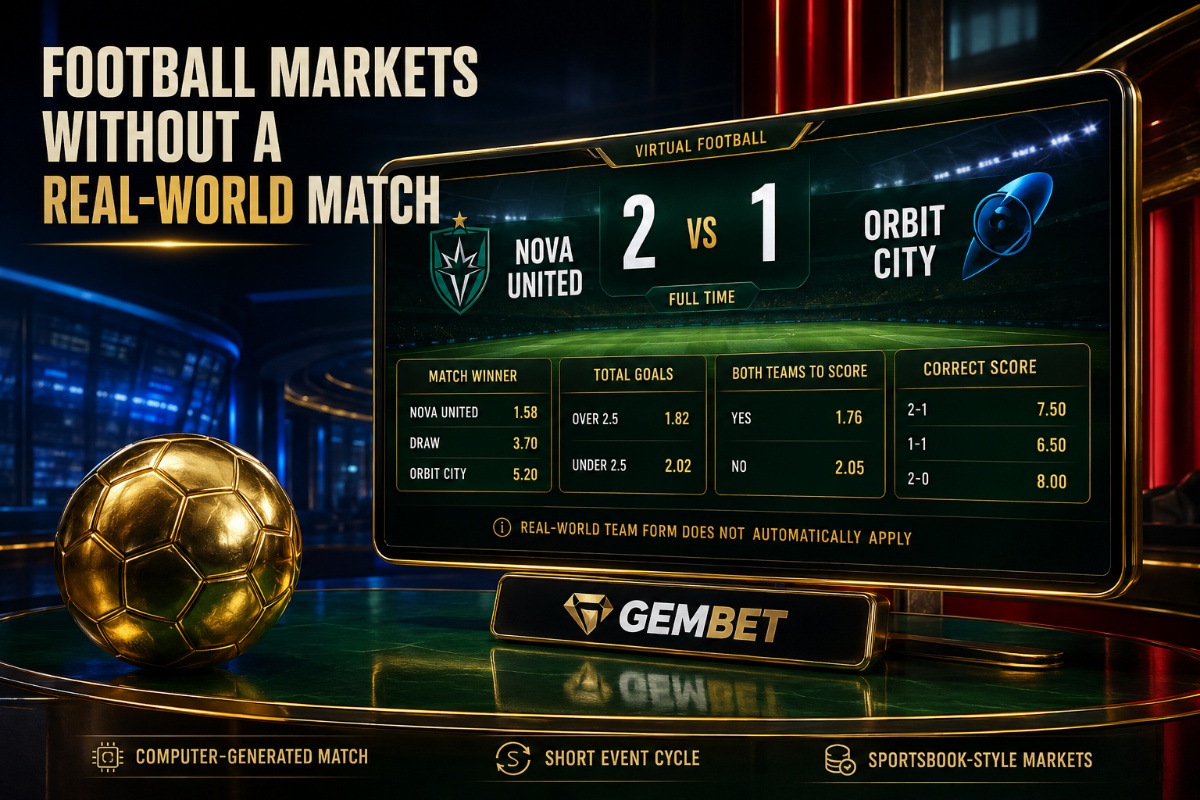
Virtual football betting is wagering on computer-generated football matches that are created specifically for betting rather than played by real clubs on a physical pitch. Fixtures run frequently, results are produced by the virtual game’s underlying system, and markets can resemble familiar football options such as match winner, total goals, correct score, and both teams to score.
The format looks like football, but it should not be analysed like a real Premier League, Champions League, or international fixture. Each virtual football match belongs to the simulation rather than a real competition. There are no injuries, weather conditions, tactical interviews, or real-world team news to research. The useful information is the market, odds, settlement rules, event schedule, and the specific virtual product being used.
Virtual football betting at a glance
| Game element | What it means |
|---|---|
| Event type | Computer-generated football match |
| Match frequency | Rounds can run repeatedly throughout the day |
| Common markets | 1X2, totals, correct score, BTTS and handicaps |
| Real team form | Not relevant unless the product explicitly uses a linked simulation model |
| Settlement | Based on the official virtual match result |
| Main difference | No real-world match needs to take place |
What is virtual football betting?
Virtual football betting is a sportsbook-style market built around simulated football events that are generated and settled digitally. A virtual fixture normally has two named teams, displayed odds, a scheduled start, and a final score, but the event is not a live real-world football match.
Virtual football is different from esports football
These categories are easy to confuse. Virtual football is generated by the virtual-sports system. Esports football usually involves human competitors playing a football video game against each other.
That distinction matters because esports can involve player skill, tournament formats, individual competitors, and scheduled matches. A virtual event follows the rules of the simulation product instead.
How does a virtual football round work?
A typical virtual football match follows a short cycle:
- Upcoming fixtures and markets appear.
- Betting opens for a limited period.
- Players choose a market and stake.
- Betting closes.
- The simulated event runs.
- The final result is confirmed.
- Eligible wagers are settled.
1X2 markets work like familiar football results
Virtual football betting commonly includes a three-way result market:
- 1 = home team wins
- X = draw
- 2 = away team wins
If the official virtual score finishes 2-1, the home selection wins. At 1-1, the draw wins. At 0-2, the away selection wins.
Total-goals markets focus on the combined score
An Over/Under market asks whether the final number of goals sits above or below a stated line. With Over 2.5 Goals, at least three goals are needed.
2-1 = 3 goals, so Over 2.5 wins
1-1 = 2 goals, so Under 2.5 wins
The winning team is irrelevant to this market. Only the combined goal total matters.
Both Teams to Score can also appear
Some virtual football betting menus include Both Teams to Score, often shortened to BTTS. A 2-1 or 1-1 score satisfies BTTS Yes because each team scores. A 3-0 or 0-0 result settles BTTS No because at least one side finishes without a goal.
BTTS and total-goals markets should be treated separately. A 3-0 result can be Over 2.5 while still being BTTS No.
Correct-score wagers require an exact result
A virtual football market can also offer exact-score selections such as 1-0, 1-1, 2-1, or 3-2. Another virtual football market may focus on totals, handicaps, or BTTS instead.
If the selection is 2-1 and the virtual match finishes 3-1, the wager loses even though the predicted team still won.
Handicap markets adjust the score for settlement
Virtual football betting may include handicap markets that give one side a virtual advantage or disadvantage. A team at -1.0 effectively gives away one goal for settlement, while +1.0 receives one.
The exact format can be Asian handicap, European handicap, or another provider-defined version. Check whether a draw or push is possible before placing the wager.
How are decimal-odds returns calculated?
With decimal odds, use:
Stake × decimal odds = total return
If S$20 is placed at 1.90 and the wager wins:
S$20 × 1.90 = S$38 total return
The net profit is S$18 because the original S$20 stake is included in the total return.
Short event cycles can increase betting frequency
One major difference in virtual football betting is speed. Real football fixtures may be separated by hours or days, while virtual events can be scheduled repeatedly.
If S$5 is placed on 20 separate rounds, total turnover becomes:
S$5 × 20 = S$100 turnover
Turnover is the amount wagered, not the amount necessarily lost. Still, frequent rounds can increase the total money put into action quickly.
Real-world football research does not transfer automatically
Checking injuries, suspensions, managers, weather, recent form, or home-stadium records makes sense for real matches. Those factors do not automatically apply to virtual football betting because the teams are part of the virtual event system.
Can previous virtual results predict the next match?
No. A sequence of previous virtual scores does not prove which result must occur next.
A history showing 2-0, 1-0, 3-1, and 2-1 does not mean a draw is due. Likewise, several high-scoring rounds do not force the next match to finish Under.
History is useful for confirming completed events, not for creating certainty about the next one.
Virtual league tables can be presentation features
Some products group simulated fixtures into leagues, tournaments, cups, or scheduled rounds. A table may display points and standings to make the presentation more familiar.
Virtual football betting can include accumulator selections
Where supported, several virtual selections may be combined into one multiple bet. Every required leg must satisfy the sportsbook’s rules for the accumulator to win.
Check whether the market covers full time or a segment
Virtual football betting can include full-match, first-half, or other period-specific markets. A first-half selection should not be judged using the final score after the complete event.
Always read the market title before confirmation, especially when several similar goal or result markets are displayed together.
What happens if a virtual event is interrupted?
Technical interruptions, cancelled rounds, or display problems should be handled according to the sportsbook’s event-settlement rules. Do not assume that an animation freezing on a particular score means the wager has been settled at that moment.
Use the recorded bet history and official event result to confirm the final status.
Virtual football versus real football betting
| Feature | Virtual Football | Real Football |
|---|---|---|
| Event source | Computer-generated | Real match |
| Match duration | Usually compressed | Real competition duration |
| Team news | Normally irrelevant | Can matter |
| Weather | Presentation only unless rules state otherwise | Can affect conditions |
| Event availability | Can run repeatedly | Depends on real schedules |
Virtual sports are separate from live casino games
The categories may sit close together in an online platform, but they use different mechanics. A Dragon Tiger game uses real-time card comparison when played in a live-dealer format. Virtual football betting uses a simulated sports event rather than cards or a live physical table.
Gembet includes virtual football among its virtual games
Gembet‘s current public casino information lists football alongside virtual horse racing and greyhound racing within its virtual-games selection. Its broader platform information also identifies virtual sports as part of the available betting mix.
If several virtual products are listed, compare the provider, event schedule, markets, odds, and settlement rules before placing a wager.
Mobile play makes the short schedule easy to miss
Because the betting window can be brief, a mobile screen should clearly display:
- Fixture name
- Market selected
- Current odds
- Stake
- Countdown to betting close
- Accepted bet status
- Official result
Eight checks before placing a virtual football bet
- Confirm that the event is virtual rather than real or esports football.
- Read the exact market.
- Check whether the wager is full match or period-specific.
- Review the accepted decimal odds.
- Confirm the stake.
- Do not use real-world team news unless the product explicitly makes it relevant.
- Treat previous virtual results as history, not predictions.
- Check the recorded settlement after the event.
Virtual football betting works best when the simulation is treated as its own product
Virtual football betting borrows familiar football language, markets, scores, and league-style presentation, but the event itself is digitally generated. The most useful information is therefore the specific market, odds, stake, event period, and settlement rules rather than real-world team form.
When using Gembet, distinguish virtual football from real sportsbook fixtures and esports before confirming the selection. Repeated events can make the format convenient, but they can also increase turnover quickly if every short round is treated as another betting opportunity.
Once the event type and market are clear, virtual football betting becomes much easier to read: the simulation produces the result, the accepted market defines what must happen, and the sportsbook settles the wager according to that recorded outcome.
Highest odds in SG for EPL & Champions League. 5-minute fast payouts via PayNow.

